Cease to be a Slave
Michael Parkman • January 20, 2019
Finding True Freedom
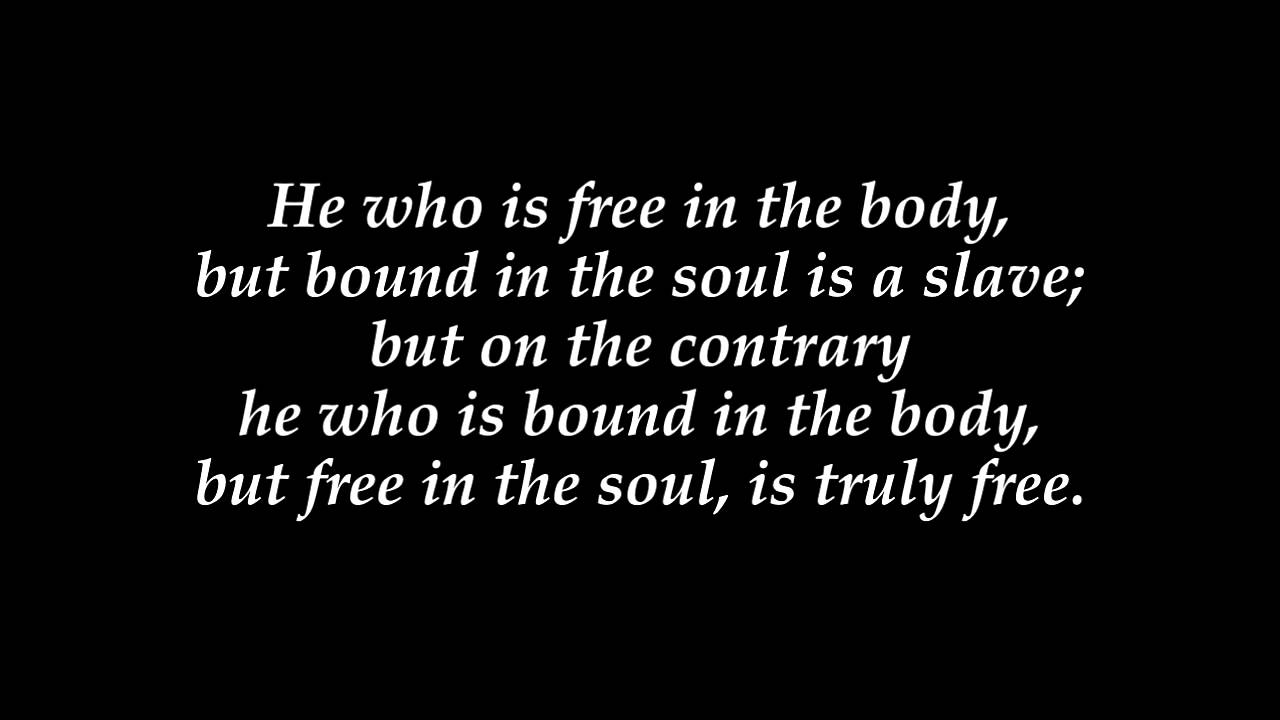
“He
is the master of every man who has the power over the things which
another person wishes or does not wish, the power to confer them on him
or to take them away. Whoever then wishes to be free let him neither
wish for anything nor avoid anything which depends on others: if he does
not observe this rule, he must be a slave. - Epictetus
If the Son therefore shall make you free, ye shall be free indeed.
New King James - John 8:36
There have been slaves on this earth for centuries. Men have been put in bondage to serve the rich and powerful, forced labor and toil with no personal benefits to look forward to except the avoidance of the lash. This is physical bondage!
Jesus, in the above quote spoke of the freedom that he gives. There were certainly still slaves in his time on earth and certainly there were believers who were still enslaved physically. However, the freedom which Jesus spoke about is freedom of spirit. The opening quote from the philosopher Epictetus explains this freedom of mind that we possess, if only we were to train ourselves to operate in it. Remember;
“He
is the master of every man who has the power over the things which
another person wishes or does not wish, the power to confer them on him
or to take them away. Whoever then wishes to be free let him neither
wish for anything nor avoid anything which depends on others: if he does
not observe this rule, he must be a slave.”
So how do we begin to cease being a slave? First you must have the understanding of what is in your power and what is in the power of others. You have partial control of your body; you can wash it, feed it, exercise it, give it medical attention but ultimately you still get ill, and death awaits us all. Thus, your body is not in your power. You complain about the weather, but your complaints don’t affect the conditions. Someone speaks ill of you, that is in their power, not yours, for their thoughts about you will be what they are, you may try to persuade them to change their opinions, but that decision is finally theirs – not yours. Truthfully there is only one thing that you have complete control over and that is your perception of an event and how you respond to it. This sounds all too easy, but I assure you it is not. We have been trained from our youth to respond to external events personally. Taking offense to someone else’s actions or words is engrained in our psyche from the moment we can understand. We by human nature are selfish and when we have a desire for something that is outside our control, we have then become a slave.
A man is desirous of an attractive female, he wishes to possess her. It is because of this desire he is subject to her whims and wishes. He in effect becomes a puppet, dancing to the pulling of the strings of the beautiful woman. In like manner the woman having a desire to live in a grander manner than she is currently, pursues a man with wealth.Because of her desire, she is also subject to the control of the wealthy male. In both instances they have become slavish. These examples show that both the man and the woman value their desires more than right-mindedness. I am not saying that it is wrong to want a beautiful woman or to better yourself. However, if it is at the expense of right-mindedness it is folly.
If the man finds himself doing things to impress the woman that he would not normally do or accept ill treatment in order to obtain her favor, he is outside the bounds of right-mindedness. If the woman in the above example accepts mental and physical abuse for the love of wealth and status, and thusly lowers her self-esteem she is most certainly outside the bounds of right-mindedness.
Consider how often we allow what should be our most valued resource-our mind to be hijacked. Your mind becomes hijacked when we attempt to make external things our focus. For when you focus on external things you become dependent, unhappy and slavish. Simply because external things are not within your power.
The only thing truly in your power is your ruling faculty (your mind). If your desires and aversions are in line with nature you will not be hindered or troubled.
“For if a person shifts their caution to their own reasoned choices and the acts of those choices, they will at the same time gain the will to avoid, but if they shift their caution away from their own reasoned choices to things not under their control, seeking to avoid what is controlled by others, they will then be agitated, fearful, and unstable.” —EPICTETUS, DISCOURSES, 2.1.12
If you want what God wants for you and you are adverse to what God does not want for you. You truly understand the serenity prayer, “God, allow me to change the things I can and accept the things I can’t and the wisdom to know the difference.” Always examine yourself when you face any situation to see that you are observing right-mindedness. Is this event or situation in my control or not. If so, proceed, if not be prepared to be indifferent to it. Remember you assign meaning to every situation. If you are upset about something it is not the “something” that makes you upset, it is your opinion that is responsible. If you can accept this small fact you will find tranquility not far off.
The great philosopher Socrates stated, “the un-examined life is not worth living.” So put every impression the test, whether it comes from an external source or internal. This moment of reflection will allow you to make a reasoned decision on how to proceed.
To reiterate:
1.Understand what is in you power and what is not
So how do we begin to cease being a slave? First you must have the understanding of what is in your power and what is in the power of others. You have partial control of your body; you can wash it, feed it, exercise it, give it medical attention but ultimately you still get ill, and death awaits us all. Thus, your body is not in your power. You complain about the weather, but your complaints don’t affect the conditions. Someone speaks ill of you, that is in their power, not yours, for their thoughts about you will be what they are, you may try to persuade them to change their opinions, but that decision is finally theirs – not yours. Truthfully there is only one thing that you have complete control over and that is your perception of an event and how you respond to it. This sounds all too easy, but I assure you it is not. We have been trained from our youth to respond to external events personally. Taking offense to someone else’s actions or words is engrained in our psyche from the moment we can understand. We by human nature are selfish and when we have a desire for something that is outside our control, we have then become a slave.
A man is desirous of an attractive female, he wishes to possess her. It is because of this desire he is subject to her whims and wishes. He in effect becomes a puppet, dancing to the pulling of the strings of the beautiful woman. In like manner the woman having a desire to live in a grander manner than she is currently, pursues a man with wealth.Because of her desire, she is also subject to the control of the wealthy male. In both instances they have become slavish. These examples show that both the man and the woman value their desires more than right-mindedness. I am not saying that it is wrong to want a beautiful woman or to better yourself. However, if it is at the expense of right-mindedness it is folly.
If the man finds himself doing things to impress the woman that he would not normally do or accept ill treatment in order to obtain her favor, he is outside the bounds of right-mindedness. If the woman in the above example accepts mental and physical abuse for the love of wealth and status, and thusly lowers her self-esteem she is most certainly outside the bounds of right-mindedness.
Consider how often we allow what should be our most valued resource-our mind to be hijacked. Your mind becomes hijacked when we attempt to make external things our focus. For when you focus on external things you become dependent, unhappy and slavish. Simply because external things are not within your power.
The only thing truly in your power is your ruling faculty (your mind). If your desires and aversions are in line with nature you will not be hindered or troubled.
“For if a person shifts their caution to their own reasoned choices and the acts of those choices, they will at the same time gain the will to avoid, but if they shift their caution away from their own reasoned choices to things not under their control, seeking to avoid what is controlled by others, they will then be agitated, fearful, and unstable.” —EPICTETUS, DISCOURSES, 2.1.12
If you want what God wants for you and you are adverse to what God does not want for you. You truly understand the serenity prayer, “God, allow me to change the things I can and accept the things I can’t and the wisdom to know the difference.” Always examine yourself when you face any situation to see that you are observing right-mindedness. Is this event or situation in my control or not. If so, proceed, if not be prepared to be indifferent to it. Remember you assign meaning to every situation. If you are upset about something it is not the “something” that makes you upset, it is your opinion that is responsible. If you can accept this small fact you will find tranquility not far off.
The great philosopher Socrates stated, “the un-examined life is not worth living.” So put every impression the test, whether it comes from an external source or internal. This moment of reflection will allow you to make a reasoned decision on how to proceed.
To reiterate:
1.Understand what is in you power and what is not
2.Take time to examine yourself before any action
3. Put selfishness aside
4. Get beyond love and grief (do not let emotions control you)
5. Exist for the good of Man
6. Make decisions based on right-mindedness
If you keep these 6 things in your mind daily you will be successful in ceasing to be a slave.
3. Put selfishness aside
4. Get beyond love and grief (do not let emotions control you)
5. Exist for the good of Man
6. Make decisions based on right-mindedness
If you keep these 6 things in your mind daily you will be successful in ceasing to be a slave.

A Succession of Steps… A journey of a thousand miles begins with a single step. – Lao-Tzu If thou faint in the day of adversity, thy strength is small. Proverbs 24:10 Beloved, believe not every spirit, but try the spirits whether they are of God: because many false prophets are gone out into the world. - 1 John 4:1 We are often admonished in life situations to see the big picture. I would agree that understanding the big picture can be helpful. Just as it can be helpful, it can be a hinderance if we focus solely on the magnitude of the situation. Consider the quote referenced above “a journey of a thousand miles begins with a single step” this is indicative of how we should approach life’s journey. The journey begins with a single movement forward, followed by another and another. Eventually each successive step allows you to reach the thousand-mile journey’s end. Our unhelpful thoughts of the length of the journey give leeway to discouragement and possible abandonment of the journey. Let’s break this down into our A. B. C. model: 1. Adversity 2. Belief 3. Consequences In this quote there is the thousand-mile journey (Adversity). We then transition to what we feel about the journey, it is long, tiresome, endless, and so forth (Belief). Finally, what actions our beliefs lead us to. (Consequences). Our problem is the big picture in this scenario. We focus on the length of the journey, add our judgments about the journey, and then we choose to act or not act based upon our judgments. If we accept that the journey is long, tiresome, and endless our subsequent actions will reflect this by our choosing to fight kicking and screaming throughout the entire journey or abandoning the journey altogether. There is a story about a dog who was leashed to a wagon, as the wagon began to move the dog was faced with two choices resist the pull of the wagon and be dragged along or willingly walk along side. Either way the dog was compelled to make the journey by virtue of the leash, the difference is in how he chose to make the journey, in tranquility or turmoil. If you change your belief about a situation, you then change the actions you take and subsequently your consequences are different. How do you change your belief about a circumstance? Use these four techniques to examine your beliefs: 1. Evidence 2. Alternatives 3. Implications 4. Usefulness What is the truth of the qoute? The journey is a thousand miles! Is it long? Long is a relative term, it is longer than a mile but shorter than five thousand miles. Is it tiresome, perhaps? Is it endless? No. There is nothing that can be done about the length of the journey for it is fixed at a thousand miles (evidence). There are alternatives to our initial judgments about the journey. There must be an internal realization that to begin our journey we must take a single step. To overcome the tiresome aspect of the journey perhaps we can schedule periodic breaks to refresh ourselves (alternatives). Our acceptance of the idea that the journey is endless is false, but our belief that the journey is endless causes us to falter. The idea that the journey is endless is refuted in the quote itself, a journey of a thousand miles (implications). This leads us to (usefulness). Are our beliefs useful at this present moment? The acceptance of the belief that the journey is endless is not only in error but certainly not helpful to the attainment of our goal, which is the completion of the thousand-mile journey. Keep in mind that our beliefs do not always equal truth! The quote from 1st John 4:1 says. “Believe not every spirit but try the spirits whether they are of God...” Try your own spirit first, for It is we who deceive ourselves more than any other. How is it that many of us would never consider lying to someone else, can so easily commit this same offence against ourselves? Remove the false impressions we accept of ourselves so that we may honestly begin to use sound judgment in all matters. Knowing others is intelligence, knowing the self is enlightenment. – Lao-Tzu If thou faint in the day of adversity, thy strength is small. Proverbs 24:10 When you are faced with any adversity in life examine the event with the tools given you. Put your thoughts and judgments to the test. Develop and strengthen this mindset. If you can honestly take this step, and follow it with another, and yet another you will be able to withstand adversity and continue along the path to The Good Life.

Proverbs 22:6 ESV Train up a child in the way he should go; even when his is old he will not depart from it. When someone makes a perceived error in judgment, the refrain is; you should’ve known better. In reality, the person who showed the lack of judgment didn’t know better, or they wouldn’t have made the decision to do as they have done. We then proceed to judge them on their inability to measure up to our standards. We fail to understand that our standards are OUR standards and are not immediately transferred to another. If we wish someone to adhere to our standards, we must take the time to teach these standards in words and our actions. The most excellent teacher’s actions precede their words and are always in agreement. We must learn not to judge people from our standpoint, allowing people are at a different place in their journey of life than we are. Also, we must consider that we were once and, in many instances, show the same lack of understanding in other areas. What is needed instead of condemnation is an attempt to show the person their error and instruct them on ways to correct or prevent repeating the mistake in the future. It is easy to criticize after an action has been taken, but we often do not follow up with correct instruction. I must ask the question, what good is criticism if it is not coupled with correction? What good does your complaint do if you leave someone discouraged but give them no avenue to alleviate their discouragement? You should be willing to teach! Correct thinking, judgment, and actions are learned behaviors. If you intend to instruct, refrain from using the phrase “common sense.” If sense was common, then there would be no need for instruction. Instruction should begin at the place your student is, not where you are. The phrase, “I shouldn’t have to tell you!” is another prime example of incorrect instruction. If something was said or done in error, it was evident that the person who committed the mistake did need to be told. Thus, the statement is foolish because there is a lack of instruction. It also shows an unwillingness to teach. If something is important enough for you to become angry if it is not done, shouldn’t there be a willingness to make your expectations known? If you impart your expectations in the beginning, there is less chance for errors at the end, and perhaps less frustration. You are probably saying that I have taught this or that, yet they still don’t understand or grasp the meaning of my teaching. Then look to yourself, for if there is a lack of understanding, you should adjust how you present your subject. You should also be mindful that your words and actions agree. People closest to you see you in all situations; they observe you in public and private. If your public and personal life are not in agreement, your words will have little effect because your actions have the loudest voice. Training should be a constant for you as long as you draw breath. Learning and the willingness to learn should be a cornerstone of your life. You should be willing to hear differing opinions not with and ear to argue but to understanding. If you should be found in error in your thinking be able to adapt and change for truth is the ultimate goal. Should someone not acquiesce to your reasoning do not resort to harsh words and violent actions for it becomes a testimony to The Good Life if you conduct yourself in accordance with the fruit of the spirit. Galatians 5:22 ESV But the fruit of the spirit is love, joy, peace, patience, kindness, goodness, faithfulness, gentleness, self-control; against such things there is no law. Every day you have an opportunity to practice these virtues. How long will you wait to train yourself become the best you can be?

Oft times, the question put to us is, what is your goal? The usual answers are related to job or family status, community recognition, public office, etc. All of these answers have one common thread; they all require the consent of someone or something else. Interwoven in this thread, but barely visible, is the fact that seeking this consent puts you at risk of abandoning your principles to satisfy your desires. The better question is, do you want to be somebody or do something? If your goal is to be somebody, then you must acquiesce to the whims of those who you perceive as being able to give you what you want. You are very desirous of a promotion at work; your supervisor has put forth a proposal that you disagree with, your supervisor has the power to grant you that promotion that you desire. Perhaps your decision making progress goes as follows; I think this proposal is misguided, but if I speak out against my supervisor, I run the risk of derailing my planned promotional assent. Perhaps I will just go along with his/her proposal to show that I am a team player! For expediency sake, and concern for your career path, you have just laid aside your principles in favor of your desire for promotion. With this transgression, you have now taken one step further into the abyss. Once you have given in to your desires at the expense of principle, it is much easier now to repeat this action going forward. Your internal arguments quiet down, and your justifications ramp up. A quote from The Story of Philosophy the author Will Durant who chronicles the work of history’s greatest philosophers, paraphrases Aristotle with the words “You are what you repeatedly do.” You are now double-minded and unstable in all your ways. The previous statement is true, no matter how you choose to see yourself. Do you want to do something? If your answer to this question is yes, you have to accept that you may be rejected, scorned, vilified, passed over for rewards because what you choose to do may conflict with the societal norms of the day. If you have selected this path, you have decided that what you do is far more critical than the random opinions of others. It is this for this reason that you persevere oft times in solitude because you believe in what you are trying to accomplish. Consider the great masters of art, Gauguin, Cezanne, Van Gogh, and Monet; the artwork of these men sell for millions of dollars in auction houses. When they were creating the artwork that would in future years sell for millions, their work was unacceptable to the patrons of the day. All of these men died in poverty. They had a desire for recognition and certainly a need for financial resources, but the lack of these things did not deter them from pursuing their craft. It could have been easy for these artists to conform to the normative art of the time for profit, but that would be to sacrifice the greater good, the maintenance of their artistic principle. I am not suggesting that we should die poverty-stricken, but I am saying that you have to stand for something even at the expense of creature comforts. There is a saying, “ if you don’t stand for something, you will fall for anything!“ Strive to do something, for the lasting effects of what you accomplish, will outlast being somebody. For when you die, the things you desired die with you!

Matthew 18:3 (NIV) 3 And he said: “Truly I tell you, unless you change and become like little children, you will never enter the kingdom of heaven. When a child is born into this world, there is one thing certain; they know nothing! Under the guidance of his/her parents’ firm but gentle hands, the child navigates this new world assimilating information daily and retaining it for future use. Unburdened by preconceived notions or historical or traditional precedents, the child is sponge-like, absorbing the voluminous amounts of information they encounter. Through reproof, correction, and consolation, the loving parent molds and shapes the child in their likeness. Genesis 1:26 (KJV) 26 And God said, Let us make man in our image, after our likeness… Consider, if you will, identical twins, similar in physical appearance, are different in personality because their social environments were different. Their image is the same; however, their likeness is not! We are all made in the image of God. To obtain the likeness is a function of God working in our lives; this is why we must be born again. Through this birthing process, you are a new creature in Christ, a child. Now being a child and operating as a child would with an open mind ready to receive every incident, impulse, information, and action as new and uncharted; we are in a position to listen to the voice of God in our lives. We should no longer be burdened by what we already “know.” It is challenging to teach someone who is already sure of what they know. Perhaps this is why it states in Matthew 18:3, “unless you change and become like little children, you will never enter the kingdom of heaven.” You must be open-minded to the things of Christ, which is possible only if you have the mind of a child. The mindset I am referring to is the beginner’s mind. When you enter a new environment, such as a new job, you know nothing; you listen to every tidbit of information provided to you in your training and interactions with seasoned workers. You purpose yourself to absorb all the information required to perform well in your new position. There is a sponge-like mental attitude that you possess when you have the beginner’s mind. You do not interrupt your learning with thoughts of what you already know, because as Socrates said, “True knowledge exists in knowing that you know nothing.” When you accept the idea that you know nothing, you are then open to everything. In the beginner’s mind, there are many possibilities; in the expert’s mind, there are few. Jesus will not allow you to bring your “expert” mind into the kingdom of heaven. He said as much in Matthew 18:3. Let’s be clear; I am not suggesting that you should not acquire knowledge; education and training is a good and profitable thing. However, I am suggesting that your learning should be used to forget what you have learned. We live in a society that praises the number of letters after your name. I have a B.A. or Master’s or a Ph. D.; therefore, I have expertise in my field of study. It is easy to rely on these letters to position yourself mentally above others by virtue of your degrees, but it is foolish to think that your formal learning is the endgame. The correct way to operate is to learn what you can and place it in storage mentally, not fixating on what you “know” but being of a clear mind that when the time comes for your learning to profit you, God can bring to your mind what is necessary for that moment. This action will come not from your conscious thought but through the operation of the Spirit. If you try to operate from your conscious mind, your thought process will keep you behind the right moment for action. If you are a boxer and during the fight, you begin to think, I should throw a right cross. While you are considering your move, your opponent strikes you; you have now experienced the problem with conscious thought. If you have adequately trained to where your body knows what to do without your mind entering into the equation, you will be able the meet the moment when it arrives with the appropriate action. We have all heard the saying, “God never comes when you call him, but he’s right on time!” Perhaps we should look at this statement in another light. When you call on God, it is a conscious action. With this deliberate action comes a desire. You have in mind what you wish the outcome to be. Your desired outcome is your focus; with this single-minded focus, you have limited God to your expectations. You have decided on the course of action that YOU think God should take on your behalf. The fault in this way of thinking is that God is not and cannot be limited to your way of thinking. The result is that you, by way of your thinking, have not received the things of God not because he didn’t provide, but because it did not come in the manner you expected. When you remove the shackles of expectations and open yourself up as a sponge-like child, God can provide you with what is necessary for you at the appropriate time. Always examine yourself to ascertain where your thoughts are, and the actions that are motivated by them. Are your thoughts leading you to actions that benefit you alone, or are they directed towards the benefit of all? As Jesus said in Luke 22:42 (KJV), “Not my will, but thine, be done.”

Picture, if you will, a clear moonlit sky. With this image, envision a calm lake, taking notice of the reflection of the moon on the calm waters. As you look at the moon and the water, you see the reflection immediately. Toss a stone into the water and observe the ripples it creates. Be sure to take note that even though the water is now turbulent, the reflection does not change. It has occurred to me that this is a perfect analogy as to how we are to reflect the image and likeness of God! Just as the water reflects the moon, we should reflect the character and nature of God. In our daily lives, there will be trouble, unexpected events, sorrow; in short, all the things that trouble our human existence can and will occur. Just as the stone tossed into the body of water creates ripples, the rock of unexpected or unfortunate experiences ripples our minds with anxiety and discontent. We must endeavor to remember even though the water ripples, the reflection remains constant. Our daily troubles do not change who God is! 1st Corinthians 10:13 (KJV) says, "There hath no temptation taken you but such as is common to man: but God is faithful, who will not suffer you to be tempted above that ye are able; but will with the temptation also make a way to escape, that ye may be able to bear it." This scripture clearly states that God will not "suffer you to be tempted above that ye are able." So if tribulations come, you have the Word of God to rely on to carry you through. If this is so, why do so many of us break under pressure? It is because you focus on the ripples and not the reflection. When you focus on the stone and the waves, it causes you to make unfortunate and uninformed decisions. The first unfortunate decision is that YOU decide that whatever you are facing is too much for you. Once you have made this decision, you are in direct opposition to God's Word. Once you are in opposition to God's Word, every decision that you make is uninformed. The decisions are uninformed because you have cut yourself out from the source of all knowledge. God has given us the ability to reason, and with such power, we are capable of so many things. Beasts of the field and all animals have not this ability. They only possess the ability to act instinctively, discerning only the immediate situation, and once there is a resolution, they move on to the next immediate circumstance. We, on the other hand, can reconcile past events, contemplate future possibilities, and make decisions in the present accordingly. To use this power of reason correctly, we must stay connected to our fuel source, the Word of God! To do otherwise would be akin to receiving a brand new car but without the means to fuel it. This brand new auto will be virtually useless without gasoline. In like manner, our ability to reason is futile without being connected to God. To be connected to God is to exercise the fruit of the Spirit. According to Galatians 5:22-23 (KJV) , "But the fruit of the Spirit is love, joy, peace, long suffering, gentleness, faith, Meekness, temperance: against such there is no law." Bushido, the warriors' way of feudal Japan, expresses these same traits; Rectitude or justice, courage, benevolence, politeness, honor, loyalty, and self-control. God has given all the tools we need to face any circumstance; our only hindrance is ourselves. Our first act is to eliminate our overblown sense of self or ego! Remember that the old man is dead and raised a new creature in Christ. Matthew 16:25 (KJV), “For whosoever will save his life shall lose it; and whosoever will lose his life for my sake shall find it.” You have been “born again,” and you must recognize and live in that reality. Whenever you encounter a situation, consider the faculty that you have to deal with it; if you meet a rude person, remember long suffering or patience. Retain temperance/self-control when you have a desire to spend money on a luxury item at the expense of necessities. Remember righteousness/justice and courage when you see injustice on any level and dare to act. When the turbulent ripples of life engulf you, remember faith, the faith you have in God. Pursue peace with all men with benevolence(love) and politeness(meekness). These are the virtues that will keep you connected with God. Without such virtues, you will lower yourselves to that of the animals by abandoning the use of reason. Remember that your mental attitude determines your physical expression. It is imperative to govern your thoughts as they are a precursor to action. For an action to take place, it had to germinate in mind first, and YOU must give consent to that thought. This process of thinking is another example where the virtue of temperance/self-control is useful; you can consent or withhold consent from every thought that comes into your mind. Honor/Honesty is of paramount importance, for without it, we can do nothing. First, start by being brutally honest with and about yourself. To change your behavior, you must recognize the need for change. Examine yourself daily and cut away all the parts that don’t reflect the fruit of the Spirit. Develop a personal plan to improve in an area every day. Journal your progress so that you may measure your success. In the world of business, there is a saying, “what gets measured, gets managed.” Keep in mind always that this is a journey, not a destination.
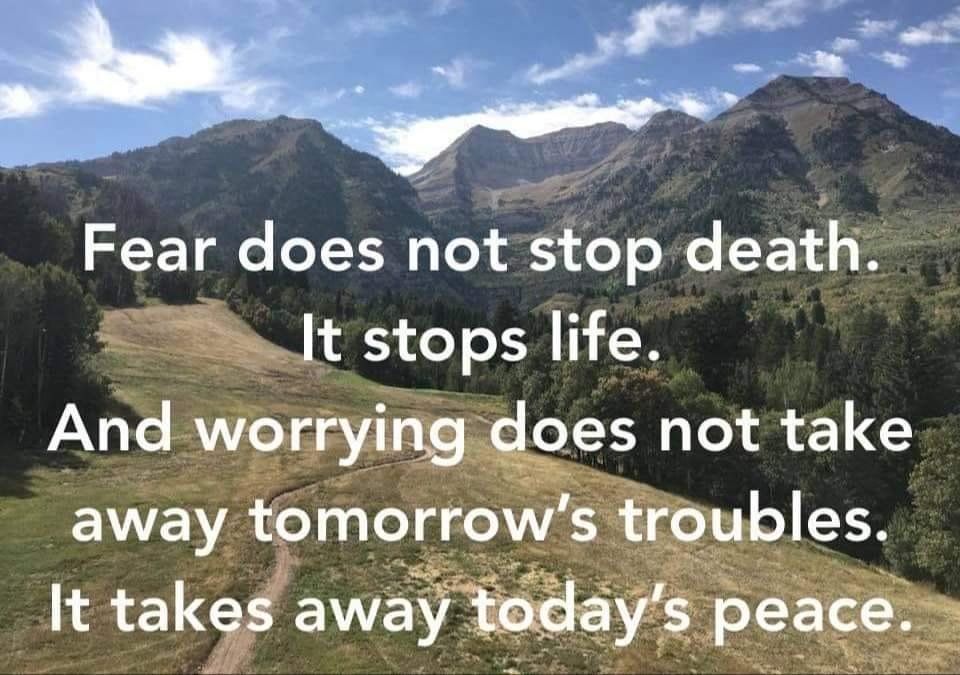
God hath not given us the spirit of fear; but of power, and of love, and of a sound mind. 2 Timothy 1:7 Fear is a driving motivator for many of us. It drives many of us to fight harder to succeed, the fear of failure drives many to greater heights. Fear as with other emotions, when carried to their due degree, is a positive phenomenon. However, when carried beyond this due degree it is a destroyer of personal tranquility and enemy to peace. There are more things, Lucilius, likely to frighten us than there are to crush us; we suffer more often in imagination than in reality. – Moral Letters to Lucilius by Seneca How many times have you been in the grip of fear about a possible situation only to find out that the situation did not occur? Your mind governed by fear overtook your reason and you spent a considerable amount of time lamenting the worst possibility that has not yet occurred if it occurs at all. During this pandemic, we are besieged by daily news reports and briefings from political leaders about the current state of our nation. Inaccurate information or flat out lies are fed to the masses daily. Uncertainty is the forefather of fear. Conflicting accounts coupled with the ever-shifting medical reports suggest to us that there is no real consensus on how to deal with the problems that this pandemic had forced upon us. The result of this confusion is fear and all of its unpleasant and destructive side effects. Fear forces us to look for an outlet for our anger over this uncertainty, more often than not it reveals itself in the form of xenophobic outbursts against any of the “others.” The fear permeates our society is evident when we single out a group or groups of people as the cause of our problems. The truth is that the majority of our problems come from within ourselves. Our deep-seated insecurities give rise to reactionary behavior targeted towards anyone or anything that we have convinced ourselves is the problem. In 1958 Datsun (Now Nissan) was introduced to America, and by the 1970s the Japanese company produced smaller more gas efficient cars than was currently being produced by the United States big three automakers. The resulting fear was that American jobs were going to be lost to the Japanese automaker. I remember news reports of people with sledgehammers pounding a Datson automobile to signify their displeasure at the “non-American” competition. This outburst did nothing to solve the real issue at hand. That issue was that the big three automakers were making large gas-guzzling vehicles during an oil shortage where gas stations were running out of gasoline and there were extensive lines at the gas stations. The problem could be solved by the big three changing direction and producing vehicles that would reflect were we were in the nation at that time. Sure it would come at a cost that most automakers were not willing to bear at first. So the anti-Japanese automaker uprising began. One of the first responses to irrational fear is to scapegoat someone or something we perceive as a threat. Oft-times that threat is only in our mind and not a reality or just plain misplaced. In today’s environment, you see people being encouraged to blame other countries for the pandemic. We wasted precious time looking for an enemy to proclaim the cause of this misery, the time we could have used to find a solution to this problem. Lack of knowledge or understanding has produced many who wish to profit off uncertainty and fear. Food and basic consumer goods prices have risen and are harder to procure. Online retailers have had to grapple with price-gouging and fraud. We are ripe for these circumstances because fear enhanced with the help of social media has clouded our reason. What is needed is a return to reason, as it says in 2nd Timothy “….we have been given a sound mind,” why on earth do we choose not to use it? If we follow Seneca’s reason, “we suffer more in imagination than reality” is it not possible to begin to objectively look a situation for what it is instead of what we imagine it to be? We have grown accustomed to adding meaning to events. In adding meaning we are coming from our perspective which can be flawed for any number of reasons. Our ego is another determining factor in our inability to effectively use reason. Our ego allows us to only view events in the prism of how this situation affects us. Our all too present self-love blinds us to the reality of any given situation. We must be willing to suppress our ego and bow to someone else's superior reason when presented to us. This is why we must see only what is there, not what our preconceived notions tell us, take the viewpoint of an observer from the hilltop viewing the valley below. When we act upon instincts we are acting closer to animals than to humans. Animals react to the moment and once that moment has passed the animal doesn’t regurgitate the meaning of the event or develop a fear of a future event. We must learn to use our God-given reason to assess a situation properly and then choose an appropriate response. When we act on impulse we are eliminating the use of reason and open ourselves up to all of the pitfalls that impulsive decisions make. Our reason should implore us to examine our attitudes, decisions, and actions to assess their effectiveness and if need be chart a different course. If you have an attitude of fear, ask yourself where does this come from? Is it based on imagination? Is it based on a prior traumatic event or concern about a possible future consequence? What are my options for dealing with this fear? Is it in my power to change anything or nothing? Asking yourself these questions will help you reason through the initial outburst of fear, or any other emotion that you may experience allowing you to rationally think through a situation and ultimately provide you with a more satisfactory outcome. Learning to manage your emotions especially fear, is a key to experience The Good Life!
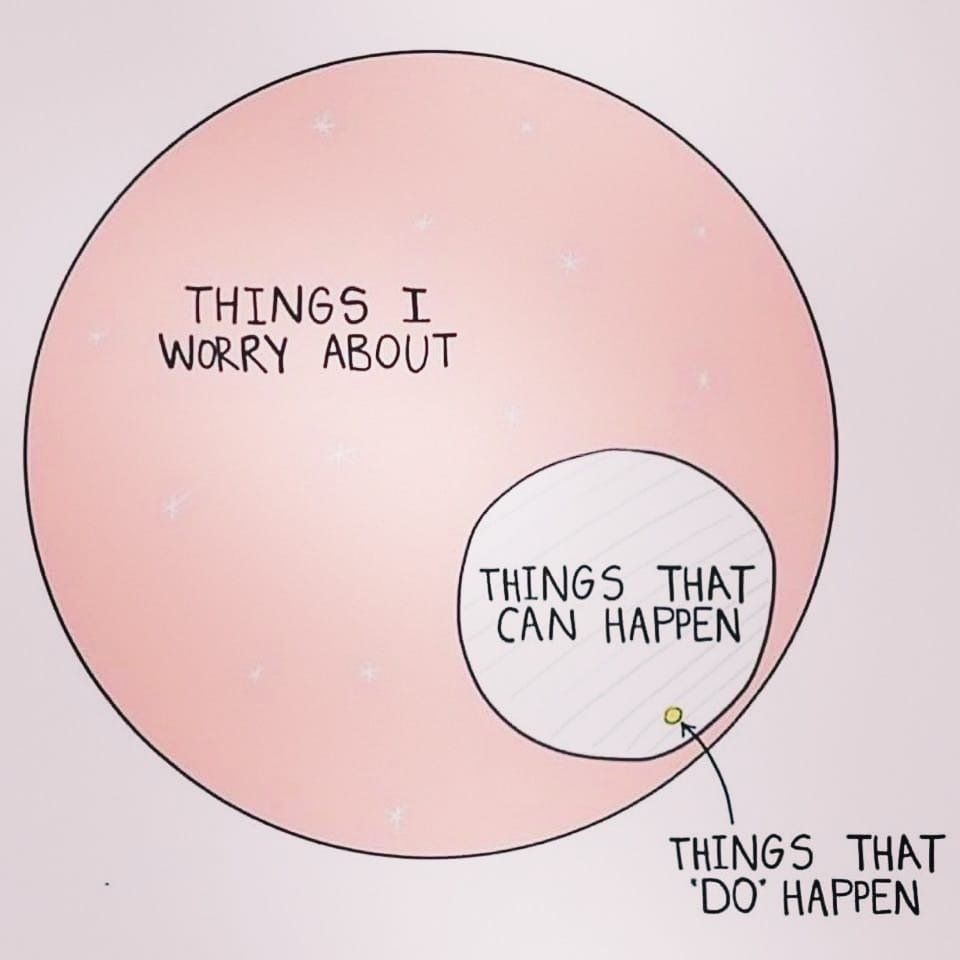
Fear is one of the most destructive emotions we experience. It is this emotion often based on our imagination that drives us into poor decisions and unwelcome consequences. You ask, but what can we do about fear? It comes upon me suddenly and oft-times without warning. I grant that sudden unexpected occurrences may bring about a fearful response, no doubt. Consider the fact that even in this instance, there is a space in which, if you keep your rational mind, you can bring that sudden fear into submission to your logical way of thinking. There is always, no matter how minute, a window that affords time for a decision. This time is bypassed in favor of a snap decision, followed by the incorrect rationale, I had no choice! What we tend to do, and what is ingrained in us is, to decide under the duress of the moment, and our words attempt to justify our judgment and subsequent actions no matter how poor the decision turned out to be. We freely give ourselves over to the emotion of the moment, that could be fear, love, anger, in fact, any emotion at all. Once we give ourselves over to passion, we cease to be in our right mind. One possible solution is that we should treat our passions in the same manner that we treat someone who is after our money! You would not give your money to just anyone, yet we freely give our mind, our most crucial possession to any fleeting emotional moment. As I stated earlier, in every situation, there are choices. We may not like the options that are before us, but they remain choices. The reason that we are dismayed at the possibilities presented to us is that we have a preference. We desire to have things the way we think they should be. The absence of the fulfillment our desire causes us to be dismayed. A better approach would be for us to deal with the situation just as it is. If we can eliminate the influence of our desire, we can then rationally deal with the problem at hand. Don’t concern yourself about the way you think things ought to be, concern yourself with the way things are! Don’t procrastinate! Fear grows stronger with time! You may think that you are getting some relief by putting an unpleasant task aside, but do you find yourself still worrying? Does that project you dread at work get any easier by delaying the start? Doesn’t your fear of the assignment grow stronger, coupled with the added stress of your superior asking for a progress report? Have the strength of character to tackle the job; you might even find that the fear that you have imagined was not at all based in reality. The truth is we suffer more in our imagination than in fact. Don’t let emotional reactions determine your response to events!
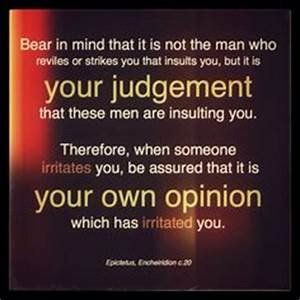
“What truly is within will be manifested without.” “Today is victory over self of yesterday. Tomorrow is victory over others.” Proverbs 23:7 states “For as a man thinketh in his heart so is he.” Your mind is indeed a powerful weapon. A weapon that is in your favor for good, or as a significant detriment to your well being. If you have reservations about this consider the times that you have prejudged someone or something and you reacted to that someone or something based on what you have previously determined to be true. How often were you prejudgments incorrect? How often did you find yourself having to alter your thought process because of new information? Do you “know” what someone is going to say or how they are going to react? The short answer is no; you do not. It is merely an opinion that you have formed. How often has that opinion been wrong? What I am trying to relate is that putting off those judging thoughts and deal with what is before you will lead to less anxiety and stress. How much simpler would it be actually to listen to what someone is saying and respond accordingly? Unfortunately, we make choices based upon preconceived opinions and suppositions based on our internal discourse. The result is more turmoil and discontentedness. Have you ever considered that the way you think brings upon you the very thing that you sought to avoid or attain? If you have an unfavorable opinion of someone, your opinion colors your actions or reactions to them. The preconceived opinions you hold increases the likelihood of getting the response you expected; negative opinion equals negative response, positive opinion equals positive response. Consider changing how you think. Put off those judging thoughts and learn to look at a situation for what it is and nothing more. Endeavor not to color an event with your opinions! If you can train yourself to accomplish this, you will see improvements in your interactions with others. Begin to educate yourself to recognize what is in your control and what is not. Start small and build yourself up as someone who lifts weights begins with lighter weights and increases the load as his strength grows. Look at something that happens in your life daily that you would typically get upset about and resolve that if you have no control over it, adapt and move on without getting angry. The battle of the mind is the war within oneself that we all must fight. To win this fight, we must recognize our shortcomings and train ourselves against these things that hinder us. Keeping in mind that if you think that you “will” or think that you “won’t,” you will be on that path very quickly. If your mindset is “will,” finding a way is paramount to your success, and you will adapt and adjust to whatever the situation is to accomplish your purpose. If your mindset is “won’t,” any obstacle deter you from your stated purpose. You will then begin to blame others for your failure, and you will accomplish nothing. Learning to use your mind correctly is the key to your success.

We are often relating to others how much we value them and their friendship. We are very fond of telling others how much we miss them when we meet them by happenstance. Unfortunately, what we say and how we act often do not match. We shower others with platitudes that are useless even before the words have dissipated into the air. If you missed someone as much as you proclaim the truth of the statement would be that you would have made an effort to communicate either in person or phone. The fact of the matter is your true value is whatever you are doing instead of contacting the ones you fervently claim to miss. The absolute truth is that the attention you give to things is proportionate to the value you place upon that thing. Consider this statement carefully! You say you value your mate, but you can’t put your phone down long enough to have a conversation. There always seems to be something that prevents you from spending the time you say you want to. The problem is not the things it is the value YOU place upon them that takes you away from what you claim to value. You say, “I love my kids.” Your actions speak something different. If you were to look at how you conduct yourself honestly, you might find that what you claim you value and what you do value are entirely different. Don’t be mistaken; others do take notice of the difference in your words and your behavior. Oft times their realization of the difference in your words and actions spurs them to withdraw from you as they begin to sense the low value you have for them. It’s not that you don’t care, it’s that you care for something more. Perhaps it is time to do an honest self-assessment to understand just where we put our attention. If we emphasize what we claim to care about instead of lip service we may see an improvement in our relationships. Others will begin to sense our sincerity, and their behavior will adjust accordingly. Human beings are not that complicated. We are what we repeatedly do. You may claim you are not a bad person, but you continually do bad things, what are you? Our actions determine who we are and how we are perceived in the world. Your words should follow your actions and not the reverse. If you value something, perhaps you should allow your actions proclaim it to the world, and make your words take a back seat.
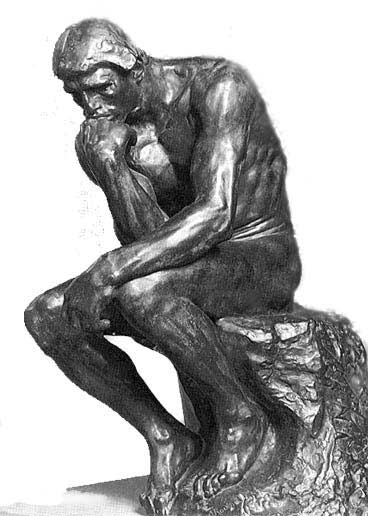
Most of us at some point in our lives has heard the statement "you are what you eat". Usually spoken in regard to encouraging someone to adopt a healthier style of food consumption. In this post I want to expand on this theme, for just as we are what we eat, we will become what we think. Before naysayers chime in I agree that you can't control all of the things that pop into your head, random thoughts are truly a fact of life. I do maintain that random thoughts lose the concept of random when we begin to entertain them or shall I say "feed" them. Every action is preceded by thought. The thought is then manifested into action. This translation from thought to action can be instantaneous, happening so quickly that you may not realize that the thought happened. By way of example you are startled by an external event. Your action is to recoil away from the event that startled you. You think you just reacted but that is not true. First, there is the event, second, the mind processes that event as threatening, and last, you take action, in this case you recoil from a perceived threat. When viewed in this manner it becomes easy to see that in all of the above referenced activity the one thing that should be acknowledged and understood is that the mind processes the event. It may have only taken a millisecond but there are three definite parts to the equation, observation ( seeing the event), perception (giving meaning to the event), and action (the response to perception. Your perception or judgement about an event is critical. For once you add meaning to an event your thoughts begin to generate the possibility of action in response to your judgement. Develop the ability to self assess so that you may understand what is the basis of your judgements. This self examination will allow you to gain control of your rational mind and give you the freedom to make better decisions. Feed yourself with virtuous thoughts such as love, kindness, benevolence, honesty, loyalty, self control and selflessness with these you can't go wrong. Once we begin to feed these thoughts they can empower the will to act in accordance with the thoughts that have been fed. The choice is yours what thoughts will you feed? Try to remember this one thing; A truly wise person is mindful of his thoughts even when he is alone!